Tag Archives: Puer Tea Knowledge

Humidity

There has been some stuff online in the last few months about Puer storage and humidity/temperature, so I thought it would be interesting to explore the issue a little. See the links at the bottom for reference.

The long dry spell here broke finally with a decent downpour. Prior to that, relative humidity (RH) had got as low as the fourties along with temperatures in the low thirties, which is exceptionally dry for Xishuangbanna.
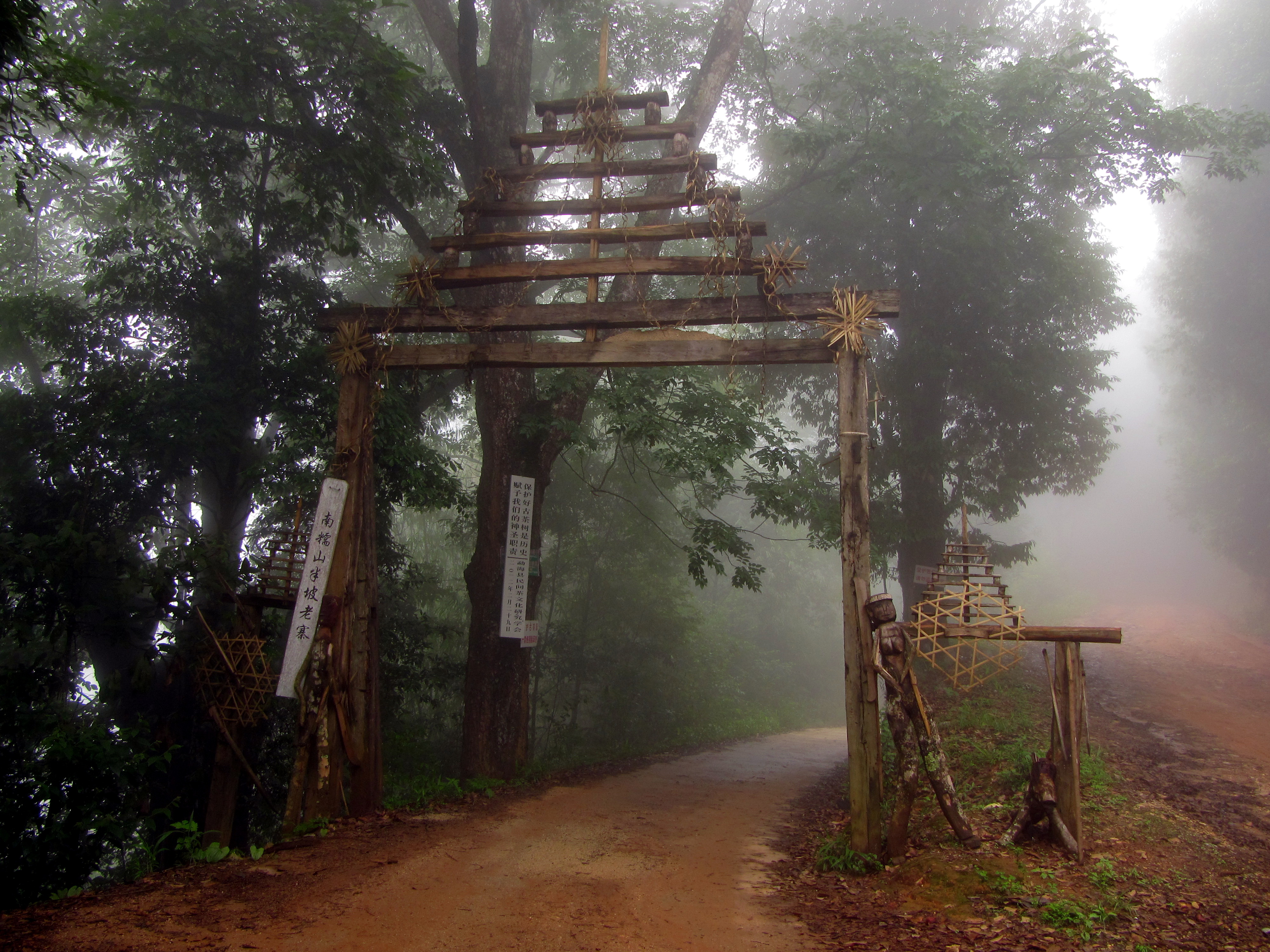
Aini village long ba men - protective gate. Nan Nuo Shan

Since then, in the last couple of weeks, the temperature has seen highs of 35°C and a low of just above 24°C. The relative humidity has been as high as 84% and as low as 44%. The highs and lows of temperature and humidity don’t of course necessarily coincide in that way; within the broader context of seasonal fluctuations, typically (here at least) humidity tends to drop as daily temperatures rise. Sitting in the shop now, at around mid-day, it is 30°C and 68% humidity.

These short term fluctuations have little impact on the ageing process of Puer tea. More long term, seasonal conditions are what is important.

You only need to tout your temperature/humidity guage around a little to realise a few things:

The first thing that is clear is that making assumptions based on generic weather record figures – assuming they somehow reflect the temperature and humidity inside one’s house, shop, or whatever – is of little value. It gives no more than a broad idea of what might be happening.

In Jinghong, where I can live with all my windows and doors open maybe 360 days of the year, there is a difference in both temperature and humidity between the inside of my apartment and the balcony (outside in the shade), and there is a further difference in a room where I have a little tea stored, to which the door is shut most of the time.

Anyone living in a climate where they are not afforded the luxury of the near ‘al’fresco’ experience that we are here, would be wise not to assume that what happens to the weather outside the house reflects too closely what happens inside.

There is also a significant difference in Jinghong between the ground floor and say the 5th or 6th: Most people in Jinghong will tell you that the ideal storage for tea is between the 2nd and 4th floors. The ground floor may be too damp, the higher floors tend to be dry.

Secondly, as MarshalN has said, it’s of questionable use to consider relative humidity without talking about the thing that it’s relative to. i.e. temperature.

Absolute humidity is the expression in g/m3 of the maximum mass of vapourised water (moisture) that a given mass of air can hold at a given temperature. RH is an expression, in percent (%), of the ratio of actual humidity to the absolute humidity.

Some dim recollection of schoolboy chemistry tells me that the more heat a volume of air contains, the more energy it has, so the faster the molecules are moving around. i.e. they are less likely to condense out and the air can consequently hold more water.

To make a couple of comparisons:

Air with a temperature of 30°C and an RH value of 70% – fairly typical for Jinghong – contains more than two times more moisture (21.36g/m3) than air at 15°C 70% RH – fairly typical of northern Europe – with an actual humidity of 9g/m3. What this means is that with the example given here, a cake of Puer tea in Jinghong would be exposed to twice as much moisture as one in say, the south of England.

Pushing the humidity without increasing temperature is not going to resolve this difference. You need both to achieve a decent Puer ageing environment.

Another example might be to compare Jinghong with say, Nan Nuo Shan, where temperatures are a good 5 to 10 degrees lower, but humidity – there is often mist in the mornings – can be high. So tea that is stored by tea farmers in sacks in their houses can often end up with a musty smell and not infrequently, obvious mould if kept there for extended periods.
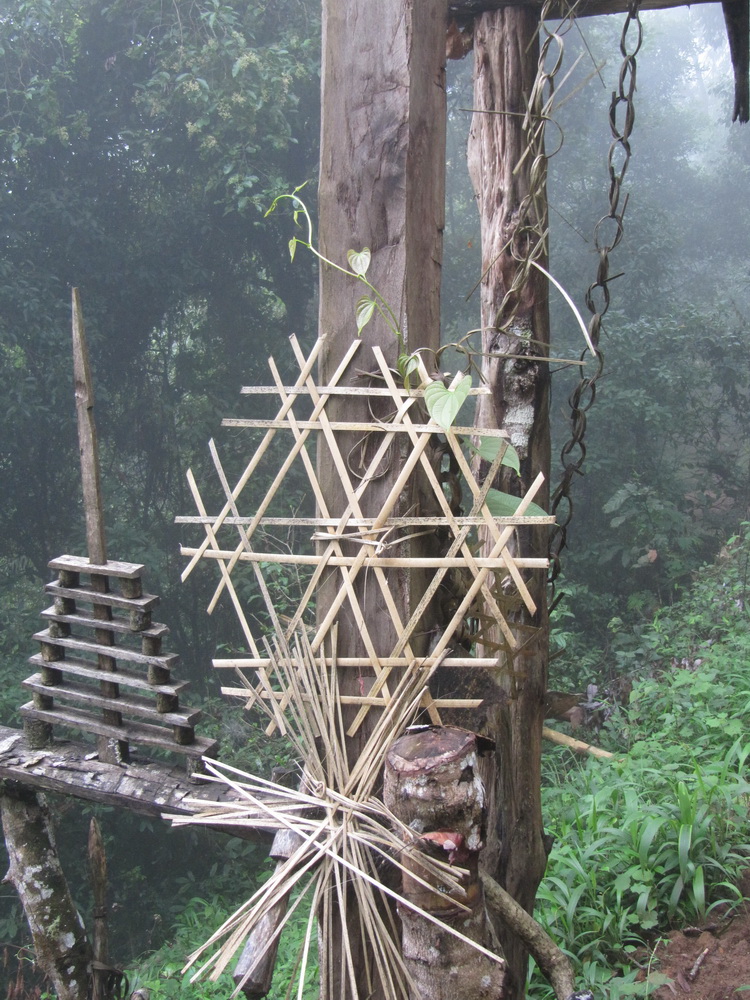
nan nuo shan long ba men detail

It seems like dew point is perhaps a more useful measurement of humidty:

Dew point is the temperature to which air would have to drop, for a given absolute humidity, for moisture to condense out – as rain, mist etc.

The dew point in our first example with 30°C and an RH value of 70% would be 24°C and for the second, 9°C. Both are quite feasible, but assume that the amount of moisture in the air would remain constant as the temperature dropped. This is perhaps not likley, but even so, dew point gives a better indication of how ‘wet’ it is than RH does. i.e. how close to the dew point air temperature is.

What this suggests is that on a day in say northern Europe, during which the RH is 70%, if the temperature fell from 15 to 9°C, water would condense out of the air and on to or into something – like your Puer tea.

long ba men - protective village gate nan nuo shan

The fact that that doesn’t happen (hopefully) is because your home is likely not as cold, or humid, as it is outside.

The other thing that is important, is written on every Puer cake wrapper, but few people seem to talk about is airflow. This does not mean a draught. But there is a big difference between 30°C and 80%RH with a little air circulation, and the same temperature and RH with no air circulation.
Half Dipper

MarshalN

Mcintosh Tea

Neighbourhood Watch

I was back in the Hekai area the other day with the guys from Cha Ye! We had dinner with the village head of Guang Gang, one of the villages that makes up He Kai.

He was explaining to me how their system of monitoring works to police the use of agro-chemicals. In 2010, the government designated seven villages in the He kai area: Ban Pen New and Old villages, Man Mai, Man Nong New and Old villages, Man Nuai and Guang Gang,(帮盆新寨,帮盆老寨,曼迈,曼弄新寨,曼弄老寨,曼囡,广冈), as having ancient tea tree gardens which must be preserved and no agro-chemicals used.

These villages together have 9,100 mu (亩), that’s just over 600 hectares, of ancient tea tree gardens.

If anyone identifies tea gardens that are being treated with agro-chemicals, the land will be taken away from the offender and given to the person who identified the transgression.

It’s certainly cannot be failsafe as there may well be people willing to collude or look the other way. At the same time, it sounds a little reminiscent of earlier times, but maybe it can work…

Tea with the Chens – From He Kai to Ge Deng

I have recently had cause to hang out with two different Chens – a Chinese name something akin to the English Smith. One in Hekai, on the edge of the Bulang Mountains, and the other from Guangdong who sources tea from the Six Famous Tea Mountains area.

Chen No1 is based in He Kai. I went up there a few weeks ago and then accompanied him to Lao Ban Zhang where he got 30 kg of fresh leaves. The cost of fresh tou chun leaves in Ban Zhang this year was anything from a little over 400 to over 600 RMB/kg, and this Spring, just over 4 kg of fresh leaves was making a kilo of mao cha.

We got back to his place with the tea around mid-day and spread it out to wilt for a while. He started frying tea later in the afternoon and continued till almost midnight, putting the tea out to dry the next morning, which is normal practice.

His sha qing approach is a little different from some tea makers as he tends to fry the tea for considerably longer than is typical, and then rolls it for a relatively short period of time. When tea is heaped in the pan during frying in the fashion described above, it is locally described as ‘dui de‘ or piled.

He Kai Chen left his tea to wilt for a fair time even though the weather’s very dry – although it had been raining a little at night when I was there – (one reason for wilting, apart from allowing the moisture content in the leaves to drop, is to allow it to even out, so that there is a more uniform amount of moisture throughout the leaf – from tip to stem. If this is not done, it’s easy to burn the leaves).

Typical tea frying woks in the Bulang Shan/Hekai/Ban Zhang area are set flat on a brick oven. Initially, the tea leaves are kept moving in the pan which must be done to stop the leaves from burning and to produce an even roast. As the tea is roasted, the heat is allowed to drop a little and the tea moved less. After frying for a while – maybe as much as 15 minutes – during which time the tea is turned and shaken out repeatedly (this allows some of the heat to disperse), the process slows down and the tea is turned and then piled in the centre of the wok and left for a minute or so. This process is repeated many times.

Chen Lao Ban then takes the tea out of the wok and leaves it on a tray for several minutes – again piled as opposed to spread out, which is the more common practice.

Making tea in this way, he then machine rolls it in an old electric roller with a wooden drum and tray, but only for a few minutes. The result is a tea that is very fragrant, has good body, with a light clear broth, little astringence and good hou yun.

When He Kai Chen makes tea completely by hand, as he did with some of the Ban Zhang tea, he does not follow this method, and has a more typical approach to frying and rolling.

Across the other side of Xishuangbanna, a few weeks later, I was in Ge Deng and bumped into another Chen. Chen Lao Ban is from Guangdong where he sells tea. He spends quite a lot of time in ‘Banna and has been sourcing/making tea in the Liu Da Cha Shan area for 5 or 6 years. He has set up a few small chu zhe suowhere he both processes fresh leaves and collects some mao cha.

Guangdong Chen has had a wok made according to his requirements: the wok is also set flat on the oven in a manner similar to Bulang Shan woks, but it’s a fair bit higher. One only has to fry tea for a few minutes in a wok in say, Nan Nuo Shan, to realise how important the height is! Most Aini people are relatively short, and build their ovens accordingly, so this can be back breaking for anyone taller.

His approach to tea making is almost as far from Hekai Chen’s as Ge Deng is from Hekai. The wilting time is probably about the same – somewhere between 3 and 5 hours, but his approach to sha qing is quite different. Tea Urchin referred to this style as ‘medium rare’. I like that description. I think a lot of people I know here would say it was ‘sha bu tou‘ – not fried enough, but Guangdong Chen (and lots of other people in Guangdong) seem to like tea with this kind of flavour; a little less smooth feeling in the mouth than is typical, a fair bit of astringency, and not much obvious fragrance; either in the leaf or the cup. And virtually none of the retro-olfactory aromas that He Kai Chen produces.

Chen Lao Ban says that when the tea is stored (in Guangdong), the astringence mellows, though I have to say, that in my (limited) experience of drinking tea in Guangdong, even after several years, tea is often still markedly ‘apre’. He Kai Chen also says his tea ages well. I have had some which was 3-4 years old which was reminiscent of a rather older tea; very smooth, good hou yunand a pleasant chen wei.

What is most interesting in all this is that Puer making methods, within a broader understanding of the process, can vary considerably. There is not necessarily any ‘right’ or ‘wrong’ way of doing things – and I suspect there never was – although it is easy to find people who will swear by one particular approach.

Road to Heaven – or is that Hell?

To pinch the title of the excellent Bill Porter book ‘Road to Heaven – Encounters with Chinese Hermits’.

Recently, one of my laoxiang (fellow countrymen) – I’ll call him Chris – has moved to Jinghong and we have been getting together fairly regularly to talk dhamma, or solve the problems of the world.

Chris first came to China 20 years ago and taught in a school in Simao. He drinks Puer regularly – maybe every day – but says he knows little about it. He’s planning to make a visit to the UK next month and wants to take some tea back with him as gifts, so he asked me what I thought about a couple teas he has.

The first, a nondescript cake of questionable origin, is making my stomach twinge just by looking at it: obviously bush tea and of very low quality at that. I told him if he threw it away, he wouldn’t be missing anything. He said he found it completely uninteresting, and could not bring himself to drink it.

The second, a cake from 2011 that he got from someone he knows up in Nan Nuo Shan, is really quite decent. I suspect the trees are not as old as would be ideal – xiao shu. but really not bad: the flavour is OK, the fragrance not bad, and the huigan is pleasing. It’s just a little too astringent to be Nan Nuo Shan gu shu.

What was interesting was that, with some exposure, even given his professed ignorance, Chris had a sense of which tea was better, even though he wasn’t able to articulate what or why. It seemed to me to exemplify the process of change which takes place, quickly or slowly, in a tea drinkers expectations.

This was reiterated when I met a German guy in Lao Feng’s tea shop recently who used to be in the confectionary business: we were remembering what Austrian Reislings were like in the 60′-80’s. How they were insanely sweet (remember glycol?), but for many, it was an acceptable first step into the world of wine. His assertion being, that the German collective palette has evolved, become more sophisticated, and people now tend to favour Reislings, or other wines that are less sweet.

Lao Feng also was telling me a couple of weeks ago about someone from Shanghai who had amassed a fair amount of Puer tea – a houseful to be more precise – but then, after finally drinking some good quality, ancient tree tea, realised that what he had was, to him at least, no longer drinkable, so he literally gave it all away.

So, Mahayana or Theravadan? Instant enlightenment or gradual cultivation? Whichever way you get there, one minute you’re not, the next you are. Then what do you do with your tea?

1,000 flavours of Lao Ban Zhang

I first met Chen Jian Ming five years ago. We went up to Hekai together where he was making tea. He has been making tea there since. He now has a shop in Jing Hong where we were trying some samples of Lao Ban Zhang that he’d got in the last few days. One was made by ‘lao bai xing’, i.e made by villagers following their own methods/standards. The other two were made by villagers, but to more exacting standards.

The other two samples were also from the village: one, the flavour somewhat fuller, the bitterness more pronounced (Lao Ban Zhang kuwei seems stronger this year than last year, for which I ‘ve heard a couple of explanantions, the most plausible of which is the climate – the dryness), the other kuwei less pronounced, more fragrant with a quicker huigan.

Lao Chen, calculates that ‘there are 500 households in Ban Zhang. If they all make tea in their own way, that means there are 500 flavours of Lao Ban Zhang tea. If each has, say 2 different tea tree gardens, then there are 1000 different flavours’ ….and so on…there was a further parameter which increased the possible variations exponentially, but I can’t think now what it was.  But you get the idea: there’re likely to be some broad similarities in tea from any village, but within that, there will be significant, often easily perceptible, variations. So having a fixed idea about ‘what this or that places tea tastes like’ is not particularly useful

Gua Feng Zhai – Cha Wang Shu – First Spring tea

HM was back up in Gua Feng Zhai about a week ago and came back with just over three and a half kilos of the first spring tea from Gua Feng Zhai’s Cha Wang Shu.

gua feng zhai mao 2012 cha

gua feng zhai mao 2012 cha

We tried the tea which at that stage was very smooth in the mouth, and sweet, but seemed a little thin in flavour. So about a week later, I thought I would try it again.

It had changed somewhat: still very smooth. The lid of the gaiwan carried the scent of  ‘flowers and honey’. The wet leaves have a dense ‘green’ aroma – a very distinct qing chou wei.  A faint hint of bitterness on the upper palate and ‘retro-olfactory’ hints of honeysuckle in the nasal cavity.

Lao Feng dropped by just as I was pouring out the second steep. We agreed it had improved in the week since we had tried it first. “The very first tips of spring” he said “it’s like an animal that’s been asleep all winter and has just awoken. It’s not fully awake yet.”

gua feng zhai cha wang shu 2012 puerh

Water, Storage – and the importance thereof

This recent blog posting by discipleoftheleaf on one of our teas – Bulang Peak 2010 seems to bring home, apart from the fine palate and descriptive skills of the author, the importance of good tea storage, and the quality of water used for steeping.

Each time we send out tea, we continue to emphasise the importance of giving tea time to acclimatise to a new environment – in my experience, this typically takes around 3 weeks. So it makes sense, if the tea has arrived from anywhere with a climate that is different from one’s own, to wait at least a couple of weeks before even bothering to try it. There is always a handful of people who can’t wait, or don’t think it matters. But it does. And I think this is particularly true of more nuanced teas.

The importance of water quality is also fundamental. There is an essential choice to be made; find teas that suit your water, or find water to suit your tea.

There’s not much point in using water with significant amounts of dissolved solids, and along with that, probably quite high alkalinity on a complex, fragrant, nuanced tea. If one is set on water with a higher pH, better to seek out teas that work with that kind of water. Younger teas seem more fickle than older Puers which, with age, are more robust and tolerant of a wider range of conditions.

Tea Moments – Drinking Tea with Lao Feng. Bang Wai 2011

HM had gone to Menghai to organise some pressings the other day when our neighbour Lao Feng, dropped by. He somehow seems to me like a kindred spirit and I enjoy drinking tea with him.

He came in, and having said he didn’t mind what tea we drank, I found a cake of Bang Wai on the shelf that I didn’t remember ever tasting (in fact I’m pretty sure now I never tried it).  We made a number of 150gram cakes last spring from a range of tea mountains: He Kai, Jing Mai, Naka, Luo Shui Dong, Ding Jia Zhai, Mang Zhi, Bing Dao, Xi gui, Bang Wai, Ban Ma. All in small quantities. At most we had a set or two of each: 10 or 20 Kg.

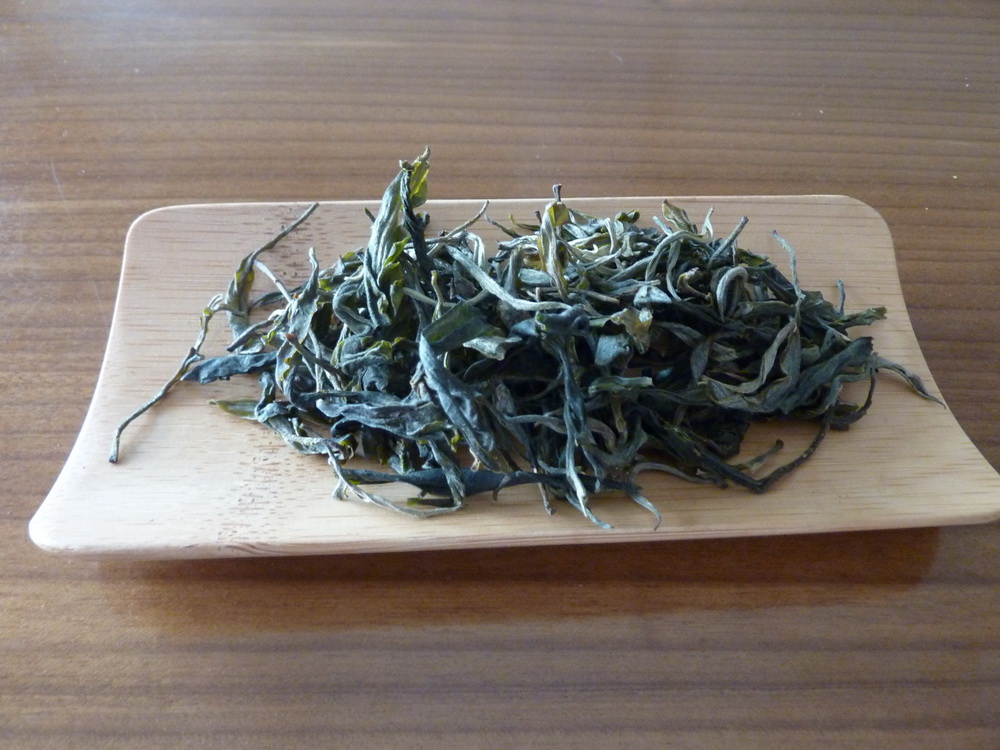
The Bang Wai tea looks good, though there’s nothing particularly notable from the outwards appearance of the leaves.

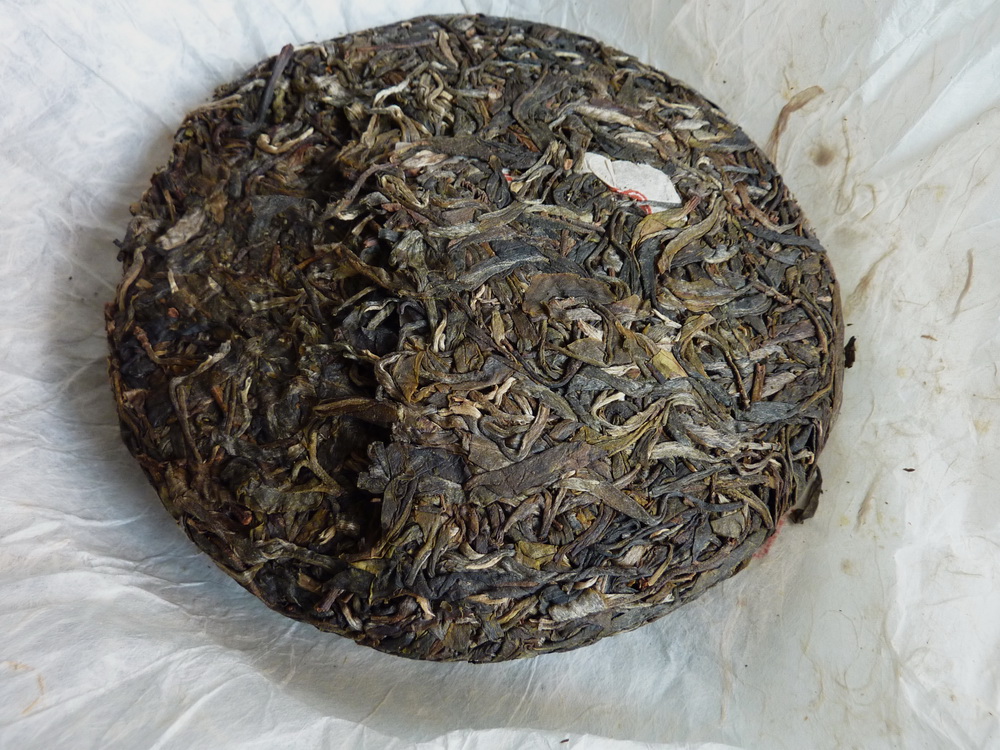
Bang Wai 250 gram cake

Bang Wai 250 gram cake from Spring 2012

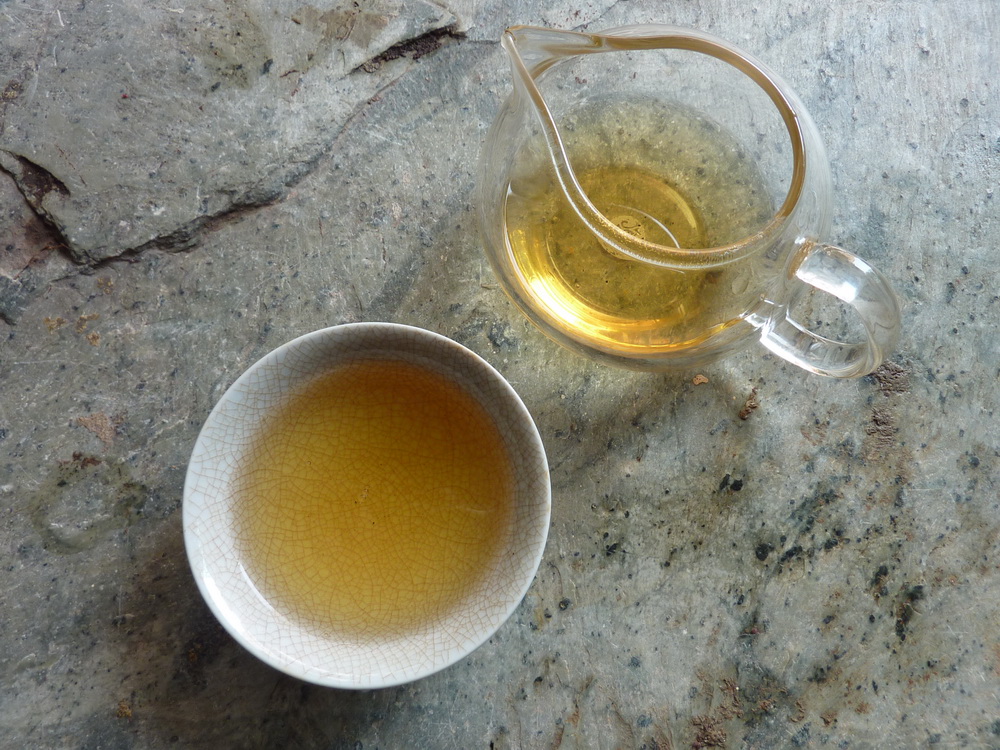
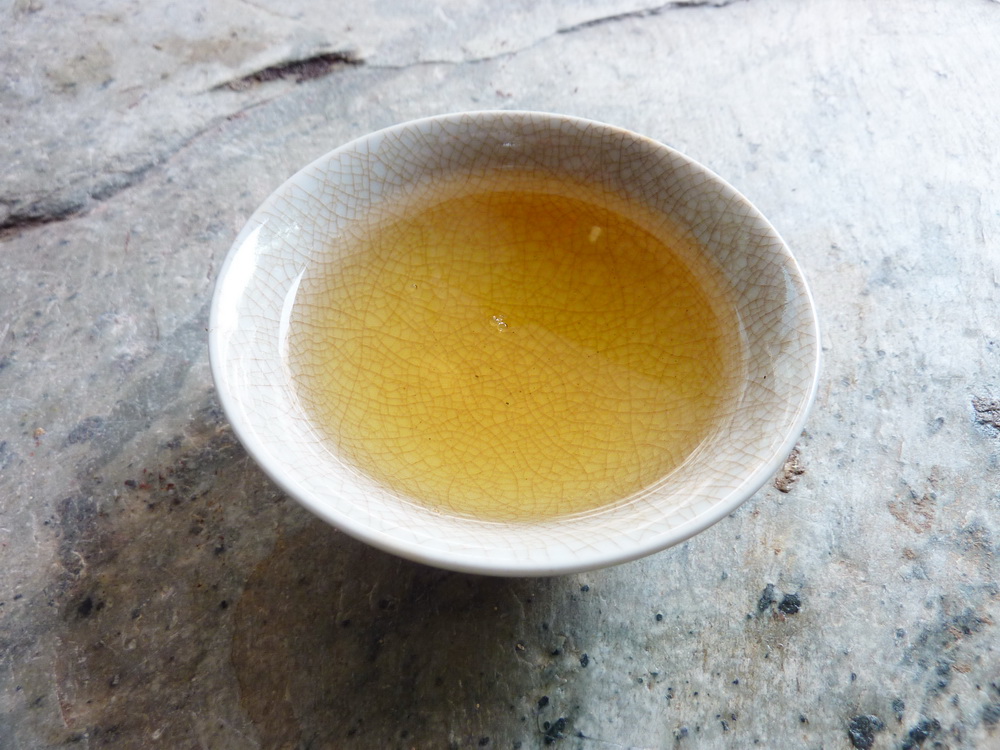
The broth is exceptionally clean. Early steepings produced a pale yellow broth with virtually no astringency and a hint of bitterness that lingered on the upper palate. Later steepings produced a pleasing rich gold broth.

Bang Wai 2012 Spring sheng Puerh broth

Bang Wai 2011 Spring sheng Puerh broth

The tea has lost any ??? ‘qing chou wei‘ that it had and has yet to develop any noticeable ?? ‘chen wei’.  Initial impressions are of tobacco and old books, hints of leather.

By the end of the first couple of steepings, I could feel a warmth creeping up my occiput and face. The tea feels quite penetrating and both Lao Feng and I begin to feel the effects in the palms of our hands: a warmth and energy that makes the skin slightly moist. I can also feel it around my upper arms and shoulders.

Sharing tea experiences with Lao Feng is enjoyable, not least because he is very interested in the energetics of tea. Not from a scientific, Newtonian perspective, but from an experiential one. We concur that one sign of a good tea is how much it penetrates energetically. He comments that ‘some teas are powerful as they enter, and some powerful as they come out.’ It’s certainly so with this tea. The rukou had no clear sweetness or xiang qi – but there is a powerful, floral sweetness that floats up through the throat from somewhere deeper inside and penetrates the nasal cavity.

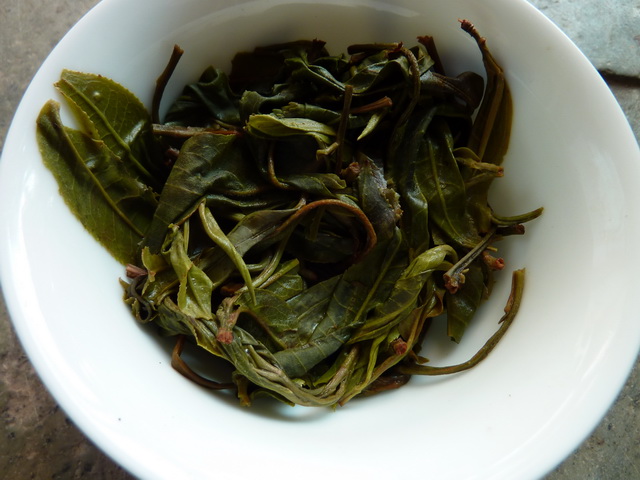
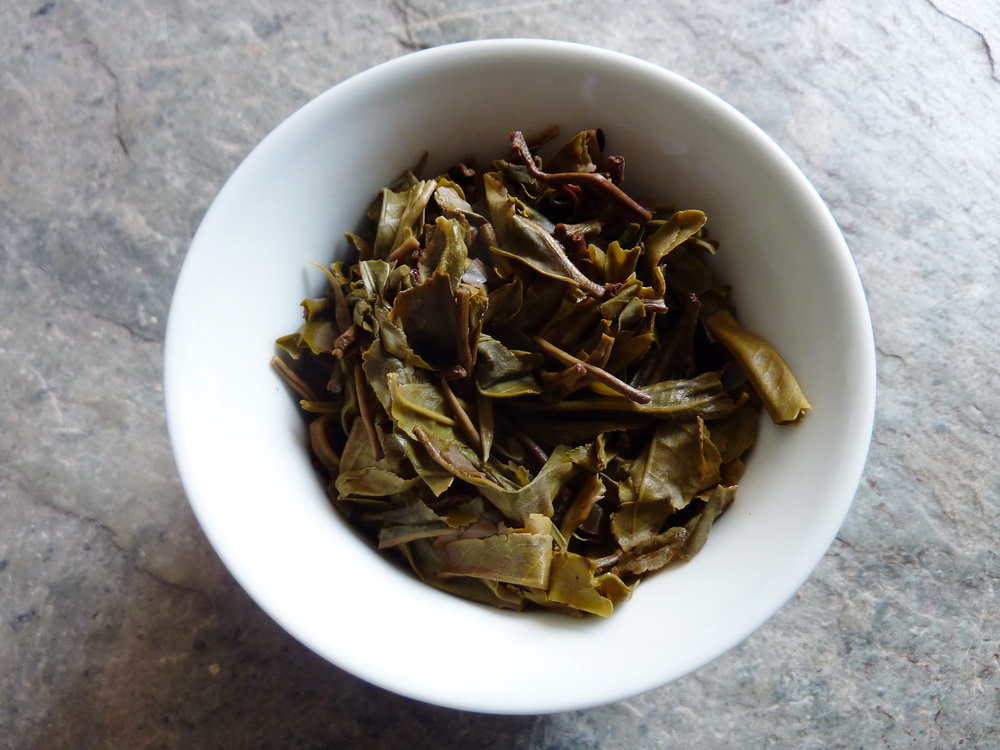
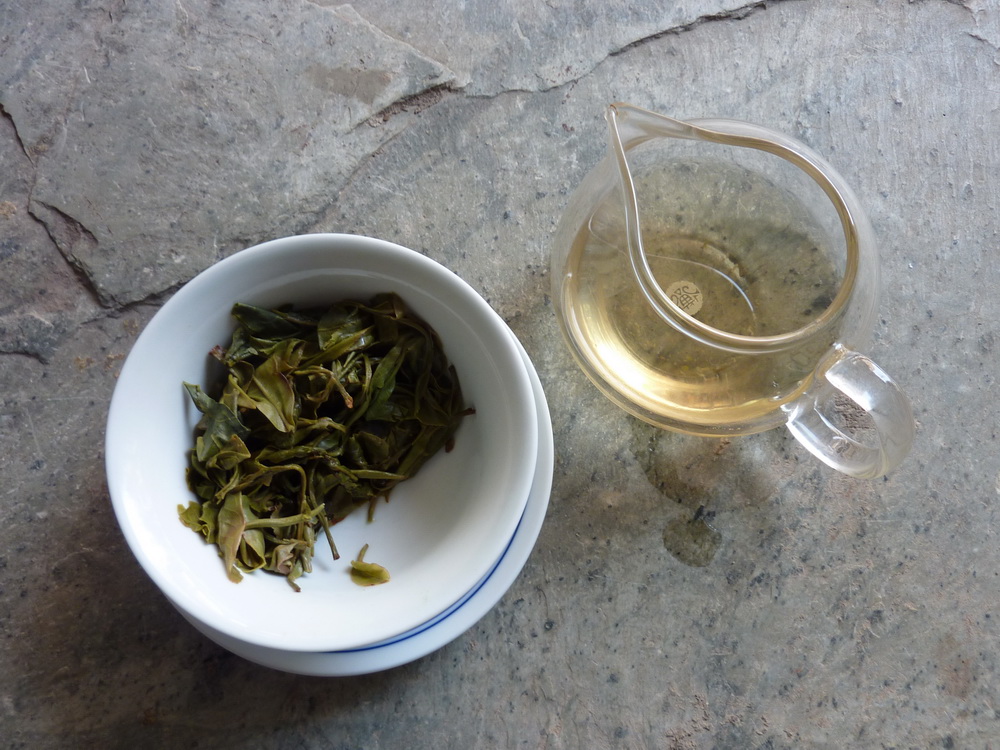
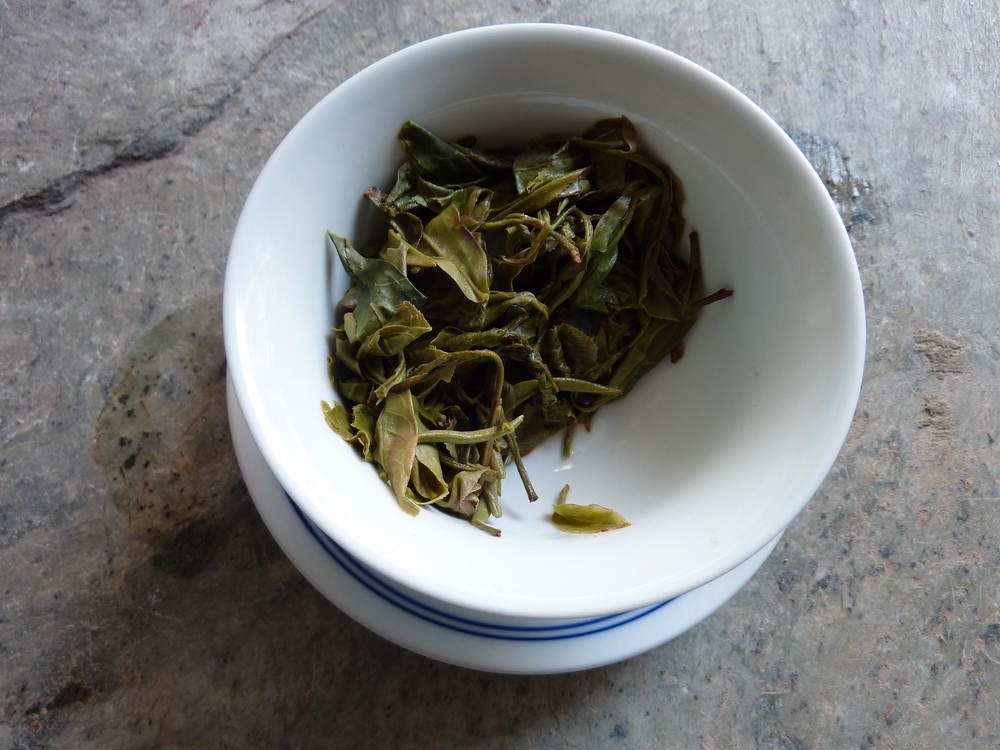
Bang Wai leaves after 5 or 6 steepings

Bang Wai leaves after 5 or 6 steepings

We become very still as we focus inward to better perceive/appreciate the process. Another friend comes by and quietly joins in. He too, quickly notices the effects this tea produces. He says he feels it first penetrates to the 丹田 ‘dan tian’ and then spreads out to the hands.

We recall a Chinese sage – no one can remember their name – who said about only drinking seven cups of tea. With this tea, it seems to be true. The experience is quite powerful and after 5 or six steeping we’re all happy to pause and enjoy the lingering sweetness and aroma that continues to float up in the throat for another 40 minutes or so.

 Bang Wai broth after 6 - 7 steepings

Meng Song Ku Cha – Bitter Tea

Sinensis assamica var. Kucha – or in plain English, bitter tea, is a sub-variety of sinensis assamica that grows in the Meng Song area. For reasons which are doubtless obvious, it’s not the most sought after of Puer tea, but with a light touch when brewing it can be rather pleasant, with a distinct, lingering, but not overwhelming bitterness.

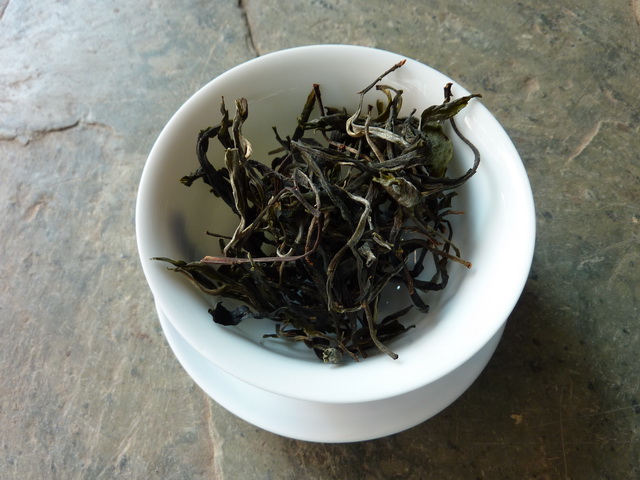
A friend just dropped by with a few handfuls. We plopped some in the gaiwan. It’s not the prettiest maocha you’ll ever see, but it’s totally honest, unadulterated.

Meng Song sinensis assamica var. kucha

With maybe 5-6 grams in the gaiwan and very quick steeping times, the bitterness does not become overpowering and there’s some decent flavour and fragrance.

Meng Song Bitter Tea leaves after three steepings

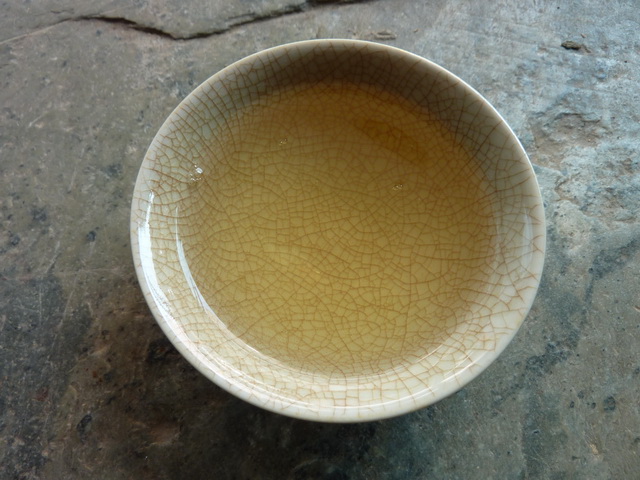
The soup is clean – when sampling it’s good to use a gaiwan – not a pot – and no strainer. The broth has a pleasing colour with a hint of pale, almost pinky, gold.

Meng Song Bitter Tea broth

See here for an earlier post about Meng Song: www.zhizhengtea.com/puerblog/stone/

Wan Gong and Bai Cha Yuan

HM has been recently spending a fair bit of time going up to Wan Gong where we found a little tea last year, and Bai Cha Yuan . Our hope this year is to build on last year and make some more tea from a couple of tea gardens up there.

Old tea tree around Wan Gong

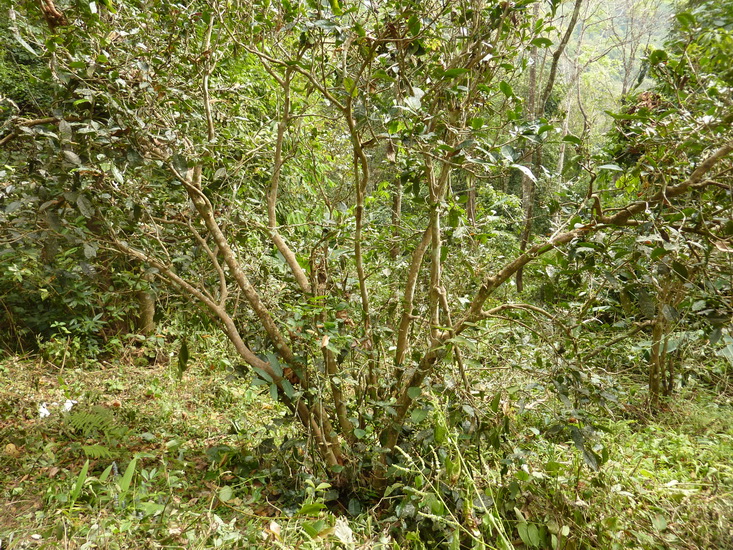
Old tea trees that were cut back and then left untended

The trees in the photo are typical of a fair number of the trees in this remote area near Bai Cha Yuan – they are maybe about 200 years old but were cut back heavily many years ago and have subsequently been left untended for a long time.

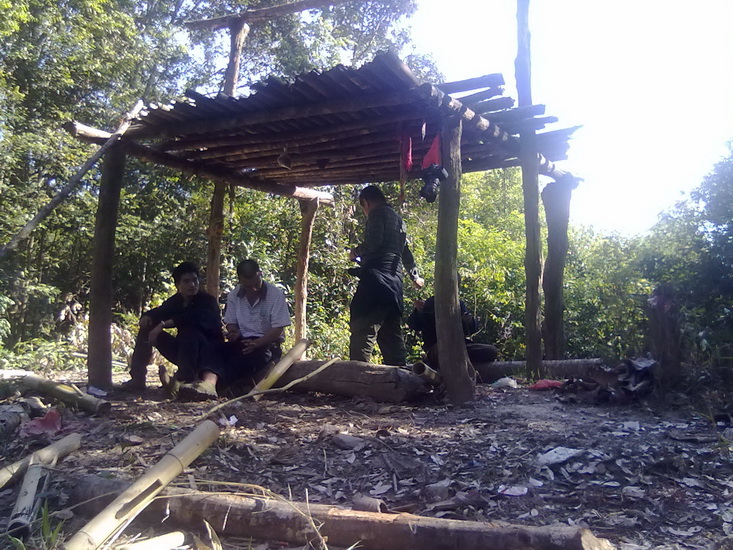
HM and some tea farmers from the area have built a small makeshift ‘pondoki’ where we will make tea, as it is much too far from any more permanent tea making facilities.

A rough shelter on the mountain

A makeshift shelter

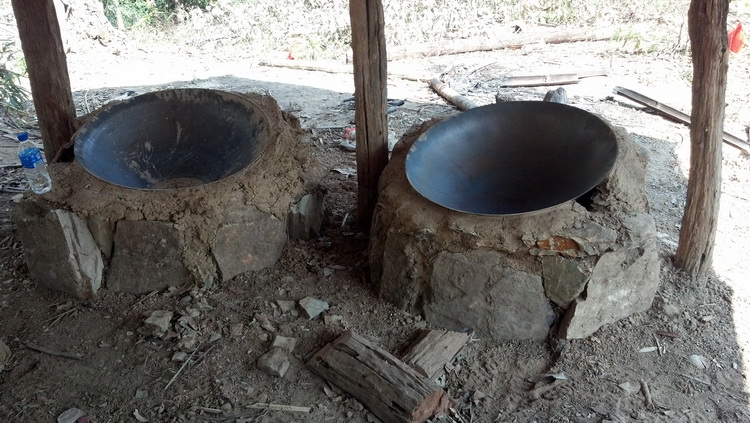
We have improvised two small woks for frying tea.

Two makeshift woks for frying tea in the field

A rather splendid view from near the top of the mountain.

A view from near the top of the mountain

A view from near the top of the mountain